Homer Watson History & Archives

The Cayleys

Thomas “Tom” Ghent Cayley was born on September 14th, 1915 in Norwich, Ontario. Tom’s family had academic and political influence: his father, Thomas Merritt Cayley, worked as a schoolteacher, principal, and insurance agent before moving on to become an active Member of Canadian Parliament.

During his youth, Tom’s interests were incredibly varied. In addition to an interest in drawing and painting, he was a member of the Oxford County Cadet team, participated in public speaking competitions, and played the trumpet in a local band known as “Con Cayley and His Collegians”. [1]

He began his post-secondary studies at the Ontario College of Art and Design in Toronto, where he studied under artists such as J.W. Beatty, John Martin Alfsen, Franklin Carmichael, Gustav Hahn, and Frederick Haines.[2] However, the start of the Second World War led to his enlistment in the Canadian Army, where he served as a part of the 46th Light Anti-Aircraft Battery.[3] Tom returned to Toronto after the end of the war, where he took up work as a commercial artist.[4]

Though portraiture was his favourite subject matter, Tom often spent hours capturing landscapes along roadsides, using either oil, pencil, or watercolour to recreate the beauty of rural Ontario.[5] This love of the arts was a significant factor in what pushed the Cayley family to purchase the Watson House in 1969 and revive the Doon School.

Tom was first married to Phyllis Grant and had three daughters, Joanne, Lorna, and Susan.

His second marriage was to Ruthe Crozier (née Tees). The couple were living in Woodstock after Tom left the commercial art business to focus on portrait art and teaching[6]  when the opportunity to buy the old house arrived.

While Tom taught art classes, Ruthe led visitors on tours of the house, sharing with them the history of Homer Watson. Ruthe was incredibly welcoming, offering visitors fresh coffee and homemade cookies on their arrival, and was integral to making the Homer Watson House a tourist stop.  In Tom’s words, “without her I’d lose 95 percent of my business”.[7]
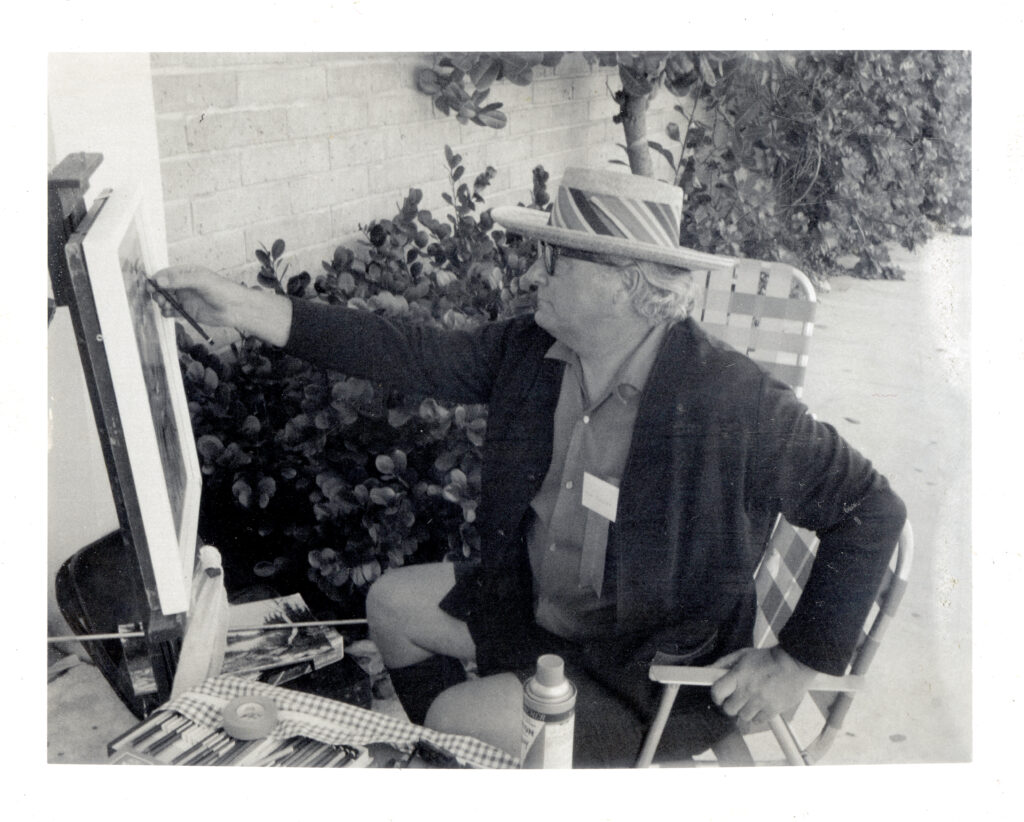
Tom Cayley at work, c.1970. HWHG Permanent Collection.
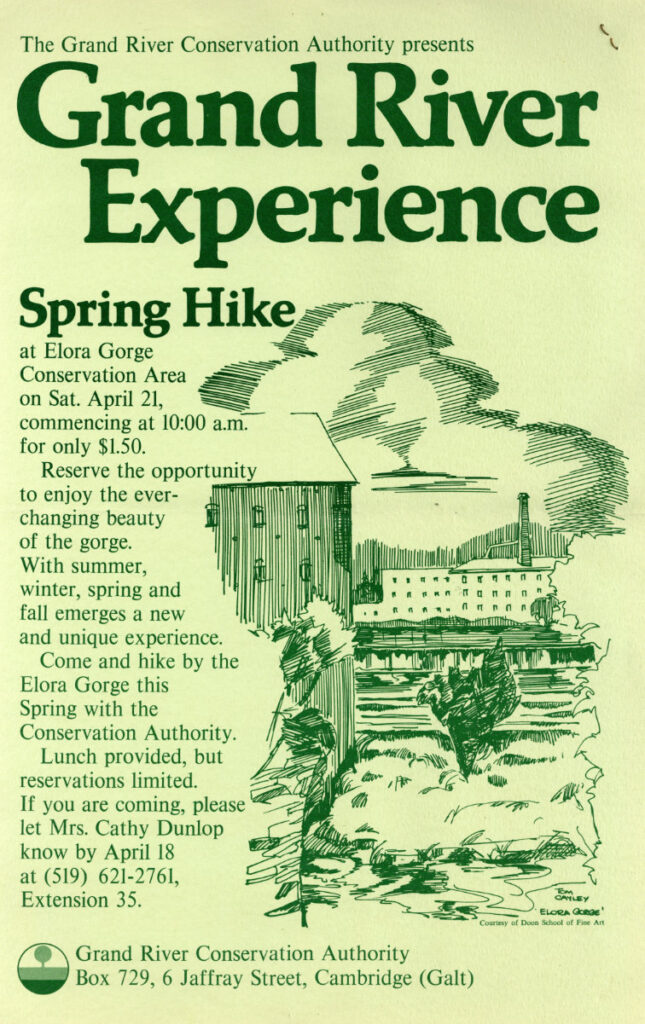
Grand River Conservation Authority, 1973. Though he eventually left the commercial art industry, Tom continued to provide drawings for various businesses and organizations.
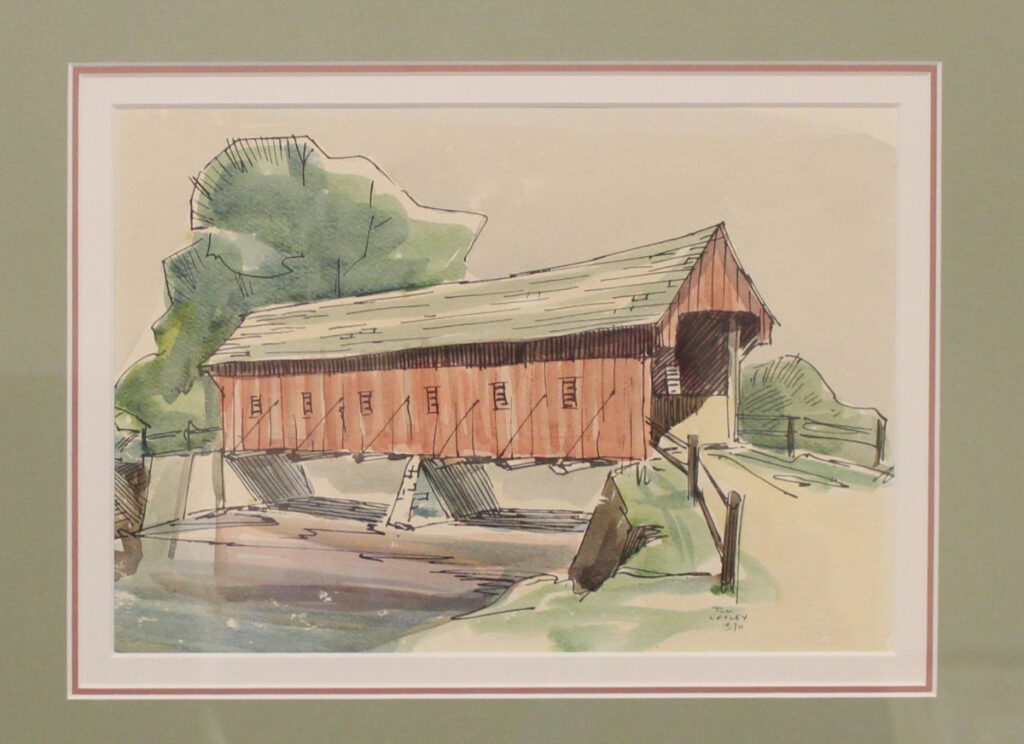
Tom Cayley, "Untitled (Kissing Bridge)" 1970. Watercolour on Paper. HWHG Permanent Collection.
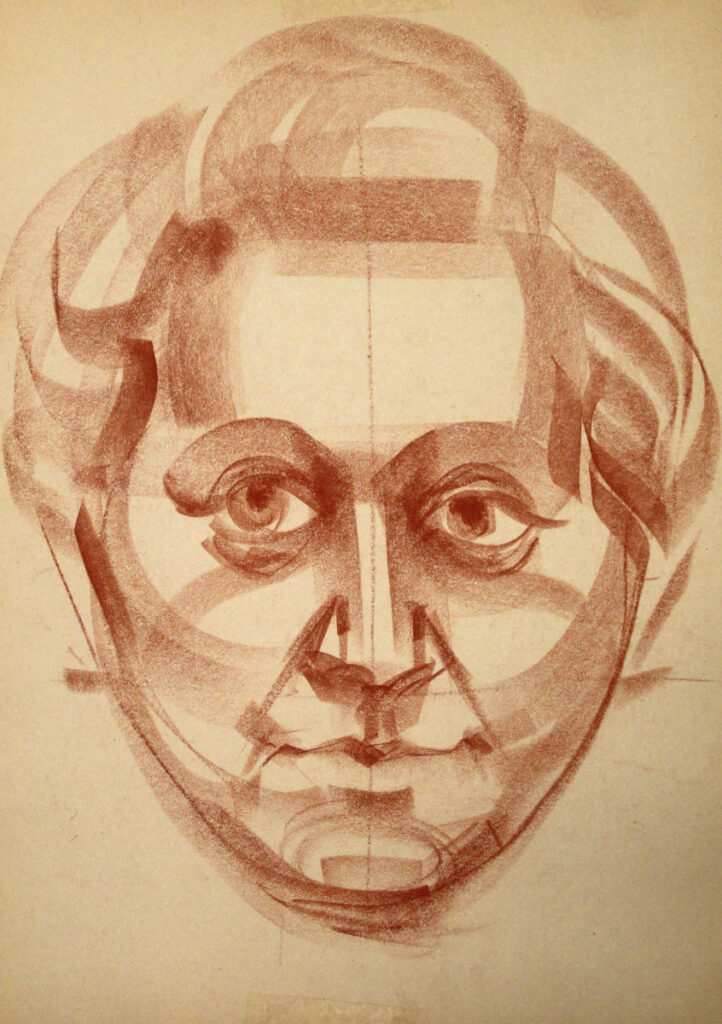
Tom Cayley, "Portrait Sketch in Sketchbook" c.1971. Conte on Paper. HWHG Permanent Collection.
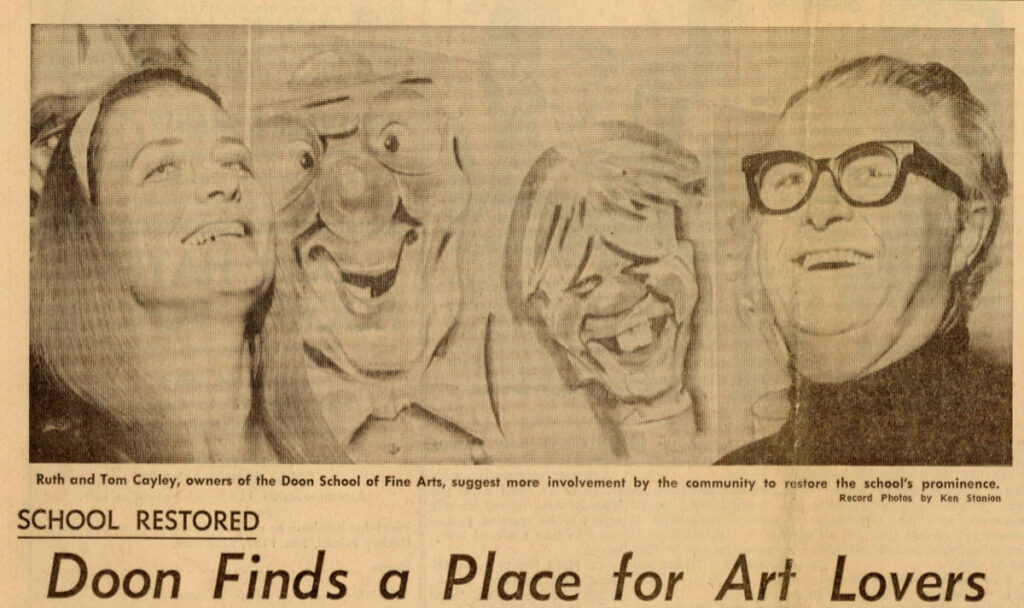
Kitchener-Waterloo Record, May 10, 1969. Tom and Ruthe Cayley purchased the Watson House from Earl Putnam in 1969. Putnam had owned the property for the last few years after the Doon School was closed by Bess Hamilton due to financial difficulties.
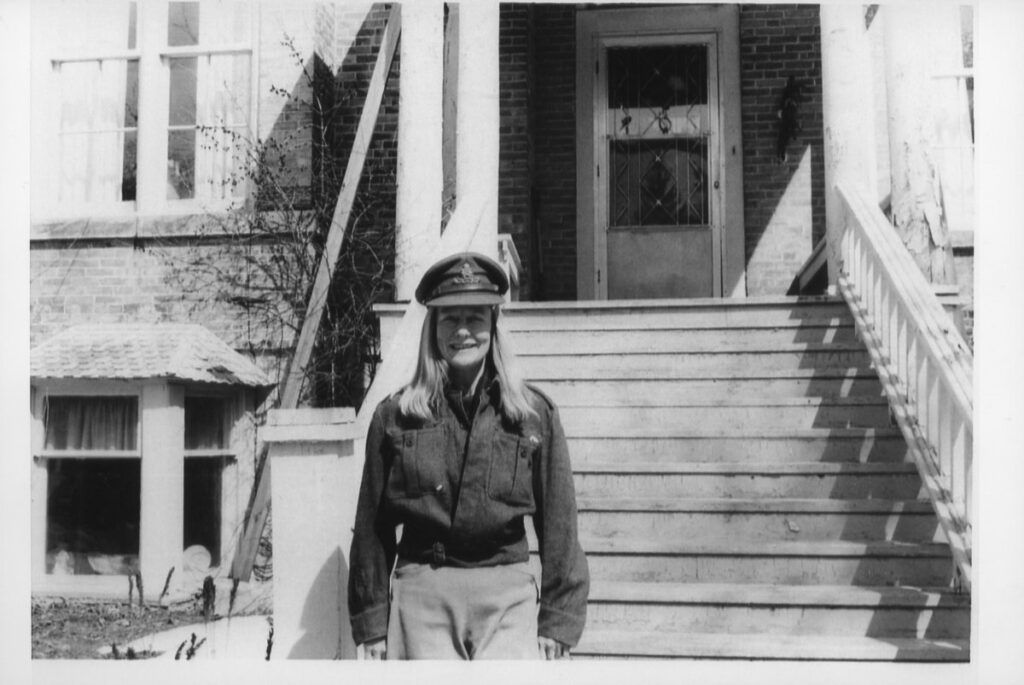
Ruthe Cayley standing in front of the Watson House, c.1970. HWHG Permanent Collection.
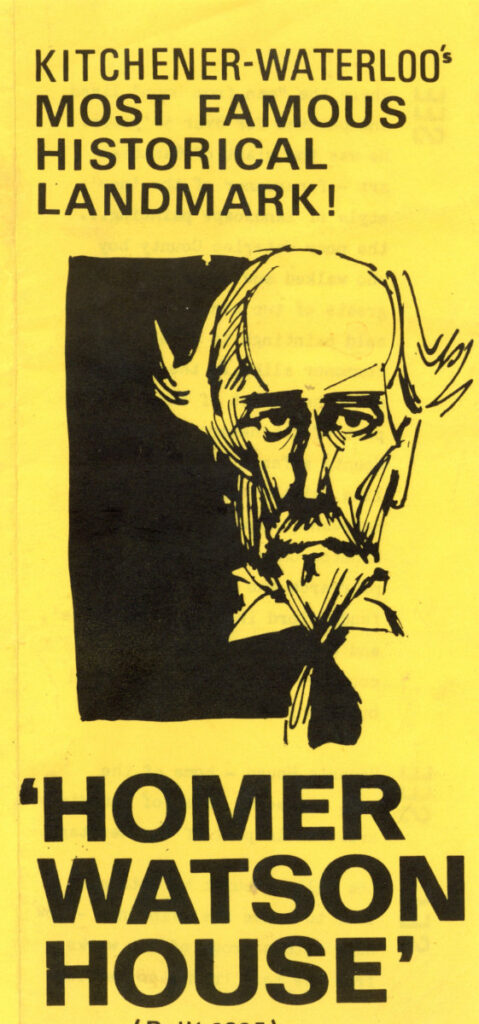
Tom Cayley made the illustrations for various brochures, posters, and other ephemera advertising the Watson House and the Doon School.

Ruthe was such a warm and welcoming woman whom you instantly felt you had known forever. When I met Tom it just added to the feeling that this was somewhere I needed to be. Tom was a very confident man and talented artist. Tom and Ruthe were the essence of Homer Watson House in those days.[8]

Sadly, Tom’s time at the Homer Watson House was cut short in 1975 when he passed away due to an unexpected error during a routine procedure for his pacemaker.[9] With the funds to run the Doon School of Fine Arts and maintain the grounds running low, Ruthe had to decide how to sell the Watson House. After a long process, the City of Kitchener bought the house from in 1981 and designated it as a historic property.

Tom and I had never asked for a grant, or help of any kind to keep up the house. I would like to see it preserved on a historical level, or at least to hear from interested persons who might know if funds are available for such a project.[10]

The legacies of the Cayley family are preserved in many ways. The most lasting memory of the Cayley’s, however, is the joy and laughter they brought to the Homer Watson House.

[1] Cayley Family Scrapbook, “Our New Orchestra”, n.d., Homer Watson House & Gallery Archives, Kitchener.
[2] Gallery 12, Tom Cayley (Waterloo: Gallery 12, 1975).
[3] Elinore Cayley Notes, n.d., Homer Watson House & Gallery Archives, Kitchener.
[4] Ernest Regehr, “Doon Finds a Place for Art Lovers”, Kitchener-Waterloo Record, May 10, 1969.
[5] Gallery 12.
[6] Doug Wilson, “School of Fine Arts is Far from Defunct”, The Evening Reporter, May 10, 1969.  
[7] Marjorie Gillies, “Realistic Art Makes Him an Oddity,” Kitchener-Waterloo Record, 7 January, 1971.
[8] Jan MacKenzie, Reminiscings and Photos of Homer Watson House Doon School of Fine Arts: 1972 & 1973, 2024.
[9] “Artist Tom Cayley dies at hospital”, Kitchener-Waterloo Record, February 7, 1975.
[10] Jeanne Graham, “One woman working to save historic homestead in Doon”, London Free Press, August 8, 1975. 

Scroll to Top