Homer & the Great War
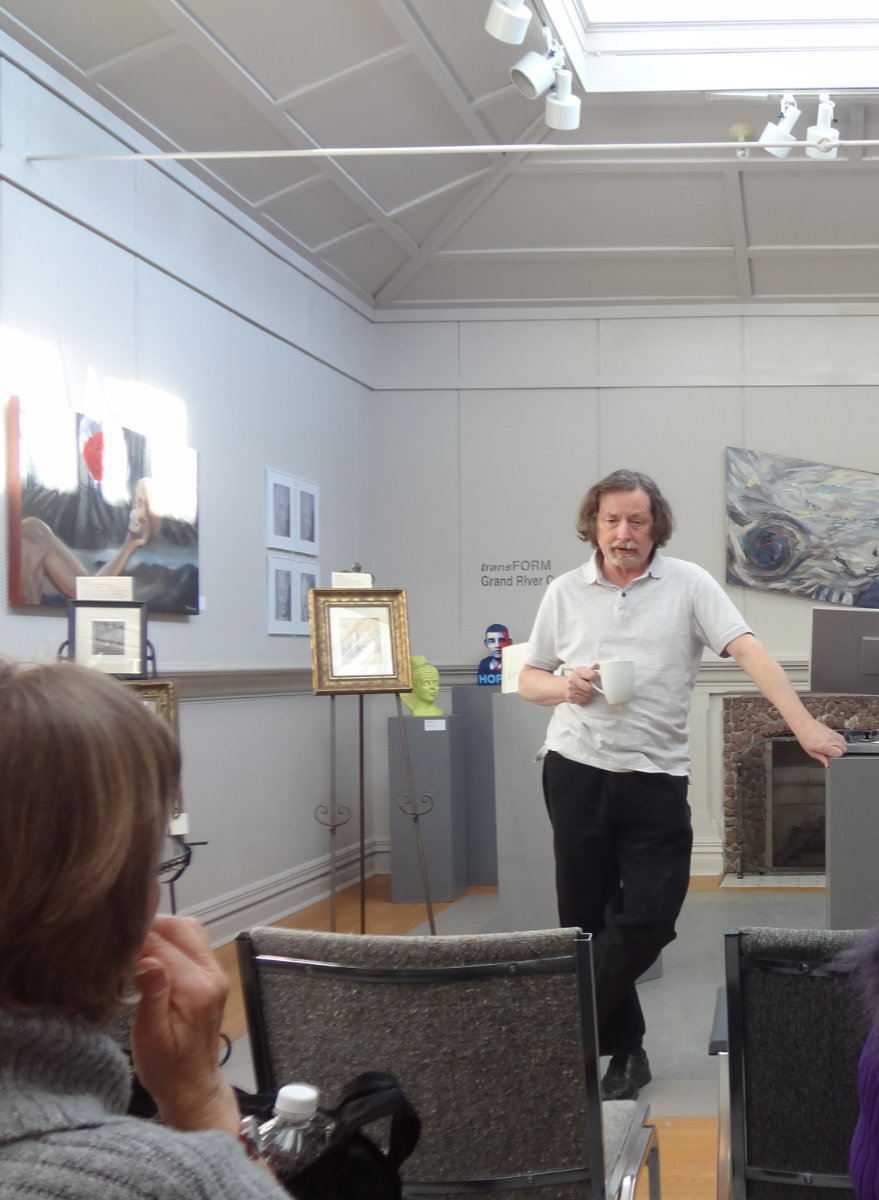
In going through a recent donation of research and documents, we found a lecture delivered right here at Homer Watson House & Gallery (HWHG), back in 2014. The researcher was rych mills, who passed away earlier this year, and always used lower case letters for his name. The lecture is robust, (51 pages!) and the research very well done. It covers Homer’s relationship with the Great War, and paintings he created about it. We would like to share some of it with you now. Thank you, rych!
Homer Watson was 60 years old at the outbreak of the First World War and therefore was not expected to join the Canadian Forces. However, he did find ways to serve his country during this time. He was commissioned multiple times to create paintings with the subject matter of the Great War.
The first to call upon Homer was Canada’s Minister of War, Sir Sam Hughes. Hughes had gathered tens of thousands of Canada’s young men at a military camp near Valcartier in Quebec in the fall of 1914 and felt the need to have this moment memorialized. He invited Homer to Valcartier Camp in Quebec, and the two agreed on a $20 000 price tag for three paintings to be created to commemorate the size and effect of the training happening at Valcartier.
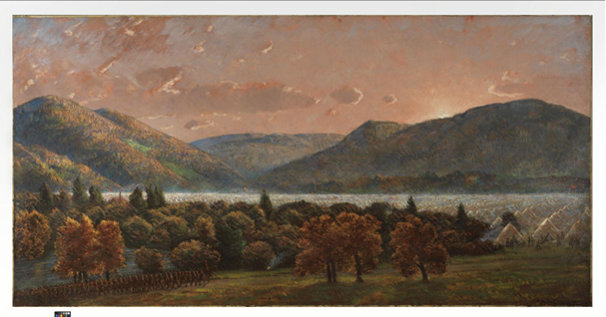
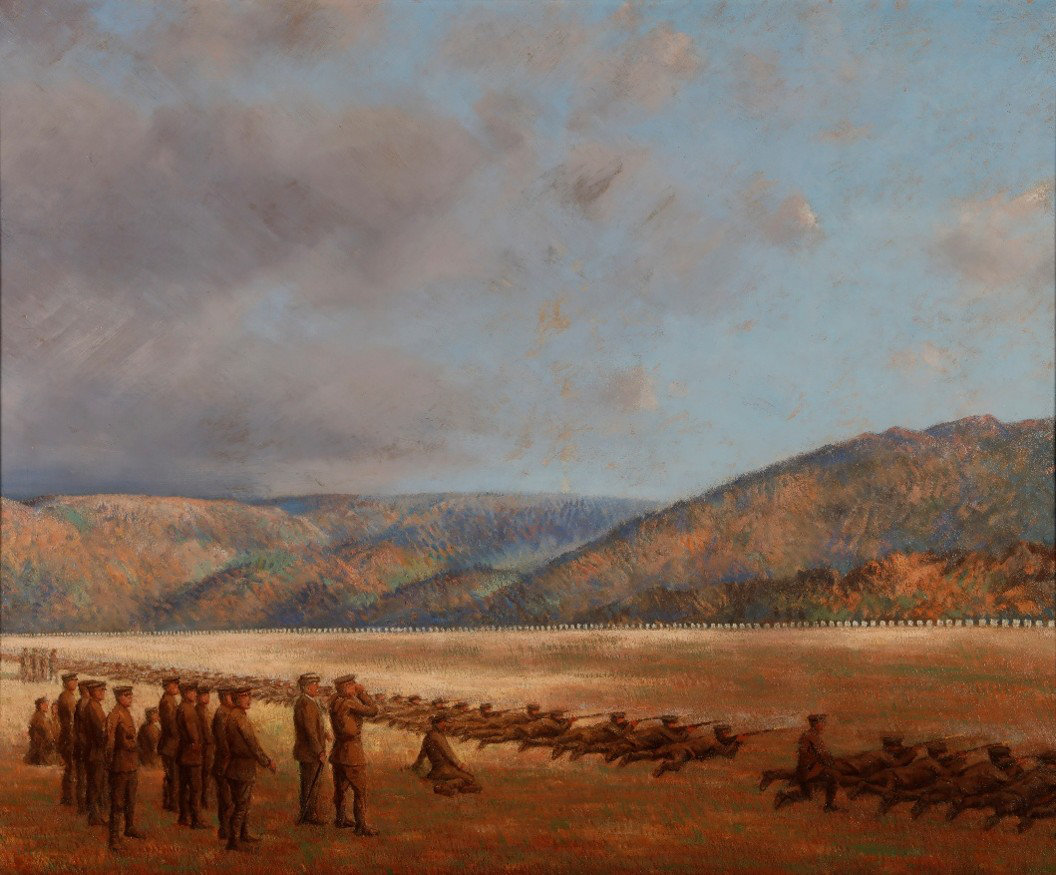

Unfortunately, Hughes had no authority to promise such payment to Homer, and by 1916 Homer had completed three Valcartier paintings that had already been displayed to help the war effort, but he had not yet been paid a single cent. This was becoming an expensive feat for Watson between his time, his travel to Valcartier, materials, and so on. Homer did eventually end up accepting $10,000 for three works: Birth of an Army, Camp at Sunrise, and The Review. The point of having these paintings created by Watson was to immediately put them on display to give people an insight to the preparations and operations that were happening for war in Canada, and potentially to encourage enlistment.
Homer worked on his three large paintings for about a year from 1914-1915. His wife, Roxa arranged for a special exhibition in the house, and raised around $300 for the Red Cross. They were then shown in the Canadian Art Club’s final exhibition in 1915 in Toronto, their most successful show ever. Also in 1915, the pieces travelled to the Annual Exhibition of the Royal Canadian Academy. The Parliament Building was supposed to be where the three works finally hung, but the famous 1916 fire which destroyed much of the building stopped that plan. Instead the first home of the paintings was the temporary parliament building, the National Archive building at the time which was called the Victoria Memorial Museum Building (today it is the Canadian Museum of Nature.)
Birth of an Army and Camp at Sunrise are both currently in the collection of the Canadian War Museum. Birth of an Army is one of Homer’s biggest pieces ever created, sitting at an impressive five feet high by ten feet wide. Camp at Sunrise is five feet high by six feet wide.
The Review has a sadder story, as it has not been seen by many alive today. The piece was loaned to the Strathcona Branch of the Royal Canadian Legion for its opening in 1952, and four years later was still hanging on the walls when a fire destroyed the building. The fire and loss were not reported to the National Gallery, who did not find out about the loss for another six years after that.
In the HWHG collection is stored a painting called Valcartier Camp. Our lecturer, rych, believed with good reason that this piece was a precursor to Birth of an Army. If you compare the two images side by side, Valcartier Camp looks like a smaller oil sketch of the massive, more detailed piece that is Birth of an Army. In the lecture, rych stated that it was possible Watson thought that it was too individualistic in terms of the soldiers and the tents, and knew this war would be won by the masses, not the individual. He made decisions to focus more on the Canadian landscape in the large version that became Birth of an Army.
Following the end of WWI, Homer was again commissioned to complete two paintings on the subject. This time, it was a man named JKL Ross, the son of Montreal Railway tycoon James Ross. JKL served with valour in the First World War, and wanted to commemorate it’s victory. We have another blog post on the subject of this titled Passage to the Unknown, which we encourage you to read to learn more about this special commission!